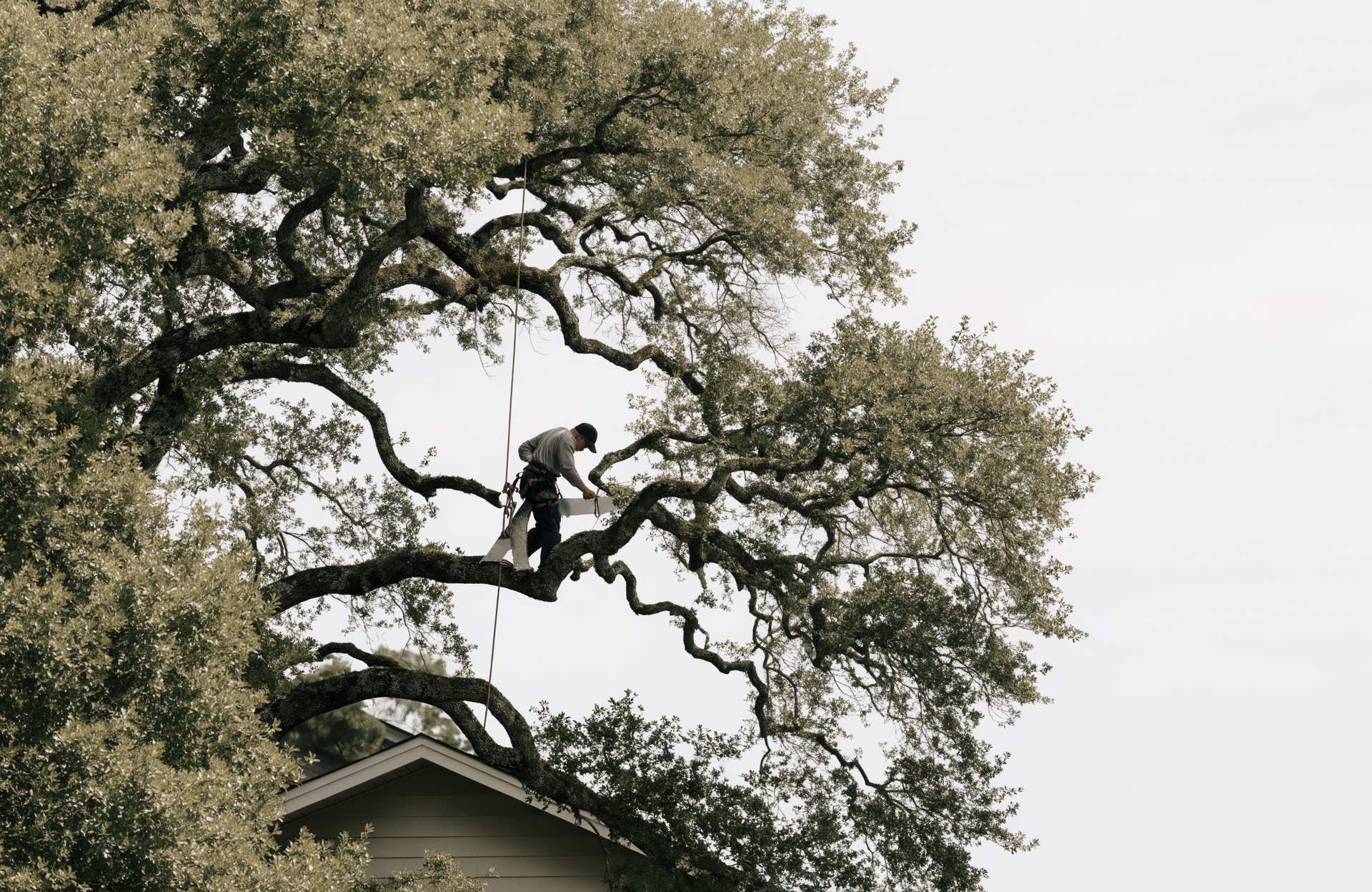
Tree Trimming vs Tree Removal: Which Does Your Tree Need?
Clearance problems are a pruning job. Structural problems are not.
The short version
- Clearance and deadwood problems are usually a trimming job.
- Decay, a lifting root plate, or a split union means removal.
- Topping is not a compromise. It creates a worse tree.
- Trimming reduces storm risk. It does not eliminate it.
The useful question is not how big the tree is or how close it sits to the house. It is whether the problem is about where the branches are, or about whether the tree is sound. Those two lead to completely different jobs at very different prices.
Trimming solves a location problem
If the tree is structurally fine and the complaint is that it is in the way, pruning is the answer and it costs a fraction of removal:
- Limbs on the roof, in the gutters, or against the siding
- Low branches over the driveway or the walk
- Growth pressing on the service drop to the house
- Dead limbs in the canopy over somewhere people park or sit
- A canopy dense enough to catch wind before storm season
These are all clearance and maintenance work. See tree trimming in Pooler for what each type of cut actually does.
Removal is for structural problems
No amount of pruning fixes a compromised trunk or root system. If any of the following is true, you are looking at a removal:
- Significant internal decay, often flagged by fungal conks at the base
- A root plate that has started to lift, with soil cracking behind the lean
- A crack running down from a union into the main stem
- A dead tree, whatever its size
- A tree that has genuinely outgrown its space and cannot be reduced enough to fix it without ruining it
Reducing a canopy takes weight off the ends of limbs. It does nothing for a trunk that has lost its structural core.
The option that looks cheap and is not
Somewhere between the two, someone will offer to top the tree. Topping means cutting limbs back to stubs with no regard for where the growth points are. It is fast, it is cheap on the day, and it is the worst thing you can do to a tree you intend to keep.
Stubs cannot seal the way a proper cut at a branch union does, so decay moves down into the trunk. The tree responds to the shock by throwing dozens of fast growing shoots that are attached only to the outer wood, which makes them far more likely to fail in wind than the limbs that were removed. Five years on you have a taller, denser, weaker tree, plus a decay problem you did not have before. Topping a tree is a removal on a delay, and you pay for both.
The mistake in storm prep
Thinning a canopy before hurricane season genuinely helps, because wind passes through instead of pushing the whole crown. But it is easy to overdo, and overdoing it is worse than leaving the tree alone.
Stripping out the interior foliage and leaving tufts of green on the ends of long bare limbs, sometimes called lion-tailing, looks tidy and moves all the weight to the far end of the lever. It also removes the interior growth that was helping those limbs stay tapered and strong. As a rule of thumb, no more than about a quarter of the live canopy should come off a healthy mature tree in a season, and less from one that is old or stressed.
When it is genuinely both
Properties with several mature trees often need a mix: one removal, and corrective pruning on the two next to it. That is a normal outcome of a site visit rather than an upsell. It is also usually cheaper to do together, since the crew and the equipment are already there.
If you are not sure which category your tree falls into, send a photo of the whole tree from a distance rather than a close-up of the problem limb. The overall shape and the base tell us far more.
Get a Free Estimate in Pooler
Send a photo of the tree and what is around it. Licensed, insured, and the debris leaves with us.
Call or text anytime. If we miss you, we’ll call you right back.