Tree removal
Planned removals for trees that are still standing. Cheaper and safer to deal with before a storm makes the decision for you.
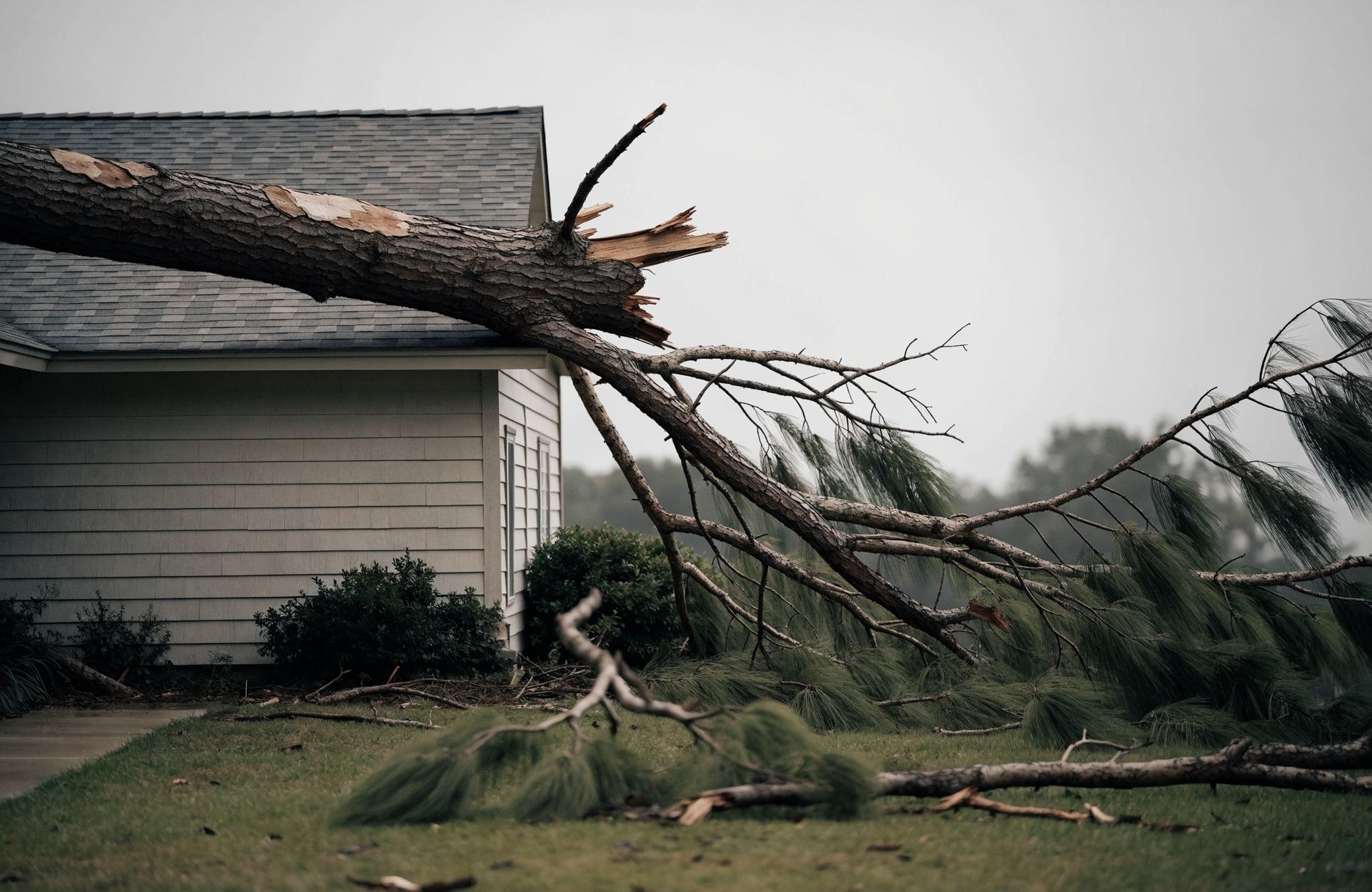
Trees on houses, across driveways, and hung up in what is left of the canopy. Storm work takes priority over our scheduled jobs, and we document the damage before we touch it.
Call or text anytime. If we miss you, we’ll call you right back.
If a tree is on a structure or a vehicle, call rather than fill this in. It is faster.
A tree that is already down is a different job from one still standing. It is usually under load, bent or pinned against something, and it is holding energy that has to be released in the right order. Cutting in the wrong place lets that energy out somewhere nobody planned for. That is the whole reason emergency work is priced and handled separately from planned tree removal in Pooler.
We take emergency calls from Pooler and across western Chatham County. Storm work moves ahead of scheduled jobs, because a pine through a roof cannot wait behind a routine removal in someone else's backyard. Hurricane season here runs June through November, and tropical systems have a long record of putting trees into houses in this part of the county, but most of our emergency calls are not hurricanes. They are summer thunderstorms with 60 mph gusts hitting a tree that was already compromised.
A tree that came down in an open part of the yard and hit nothing is not an emergency, even though it looks dramatic. That is ordinary cleanup and it costs less, so tell us what it actually landed on when you call.
When a system comes through the county, several of these land at once. We work them by hazard rather than by the order the calls arrived, which means a tree resting on an occupied bedroom goes ahead of a trunk across an empty driveway even if the driveway called first. If yours is the less urgent one we will say so rather than leave you guessing. Blocked streets slow everything down after a big storm, so when you call it helps to mention whether the road into your neighborhood is passable.
Downed conductors can energize a wet fence, a puddle, or the tree itself, and there is no way to tell by looking. Stay well clear, keep pets and children inside, and call Georgia Power and 911 before you call us. We do not cut anything in contact with an energized line. Once the utility has de-energized or cleared it, we take the tree.
We walk the site first and work out where the load actually sits, which is not always where it looks like it sits. A trunk resting on a roofline is often supported at two points with the weight hanging between them, so the sequence matters more than the sawing does. Pieces come off in an order that keeps the load controlled the whole way down, usually smallest and furthest out first, and anything over a structure gets rigged and lowered rather than cut free. Where the tree is pinning a roof, we take weight off before we take the tree off, so the structure is not left to spring back.
Once it is down, the wood and brush are loaded and hauled off and the work area is raked and blown clean. We can grind the stump on the same visit or come back for it. For the wider mess a storm leaves behind, the limb piles and debris fields across the rest of the property, see storm damage cleanup. We do not do roofing or structural repair, but we will tell you plainly what we found underneath so you know what the next trade is walking into.
Planned removals for trees that are still standing. Cheaper and safer to deal with before a storm makes the decision for you.
Limb piles, split trunks, and debris across the rest of the property once the immediate hazard is gone.
Thinning a canopy and clearing limbs off the roof before hurricane season is the cheapest storm insurance there is.
An uprooted tree leaves a root plate and a crater. Grinding and backfilling gets the yard usable again.
Usually, and the reason is the work rather than the urgency. A tree under load has to be dismantled in a specific order, often in poor footing and reduced light, sometimes with a damaged structure underneath that limits where anyone can stand. That takes longer and carries more risk than taking down the same tree standing in an open yard. We give you the price before we start, the same as any other job.
Most homeowners policies cover removal when a fallen tree has damaged a covered structure such as the house, the garage, or a fence, and many include a cap per tree or per event. A tree that falls and hits nothing is frequently not covered at all. Deductibles and limits vary enough that you need to check your own policy. Photograph the damage before any cutting starts and open the claim early. We take our own documentation set as well and can provide an itemized invoice for the adjuster.
We are a tree crew, not roofers, so we do not do structural repair. Our job ends with the tree off the building and the debris gone. We will tell you what the damage looks like from up there, which is often the first clear description anyone gets, and you will want a roofing contractor for anything beyond that.
Treat it as urgent. A hung limb, sometimes called a widowmaker, is held by friction and a few fibers, and it can come down with no warning and no wind. Park elsewhere, keep people out from under it, and do not try to pull it down with a rope from below. It is a straightforward job with the right rigging and a genuinely dangerous one without.
Removing a tree that has already failed and is creating a hazard is generally treated differently from taking down a healthy protected tree, but Pooler and Chatham County both regulate tree work and the details depend on the species, the size, and your parcel. We check what applies to your address as part of the job rather than leaving you to find out later.
Tell us what it landed on and whether anything is touching a power line. Licensed, insured, and the debris leaves with us.
Call or text anytime. If we miss you, we’ll call you right back.